Back to homepage

GPT 6.2 Astra is superhuman in mathematical optimization

Dmitry Rybin

Optimization illustration

Experiments show that a single GPT 6.2 Astra agent outperforms all human-designed software in finding and proving optimal solutions within 30-60 minutes.

Mixed-Integer Linear Programming

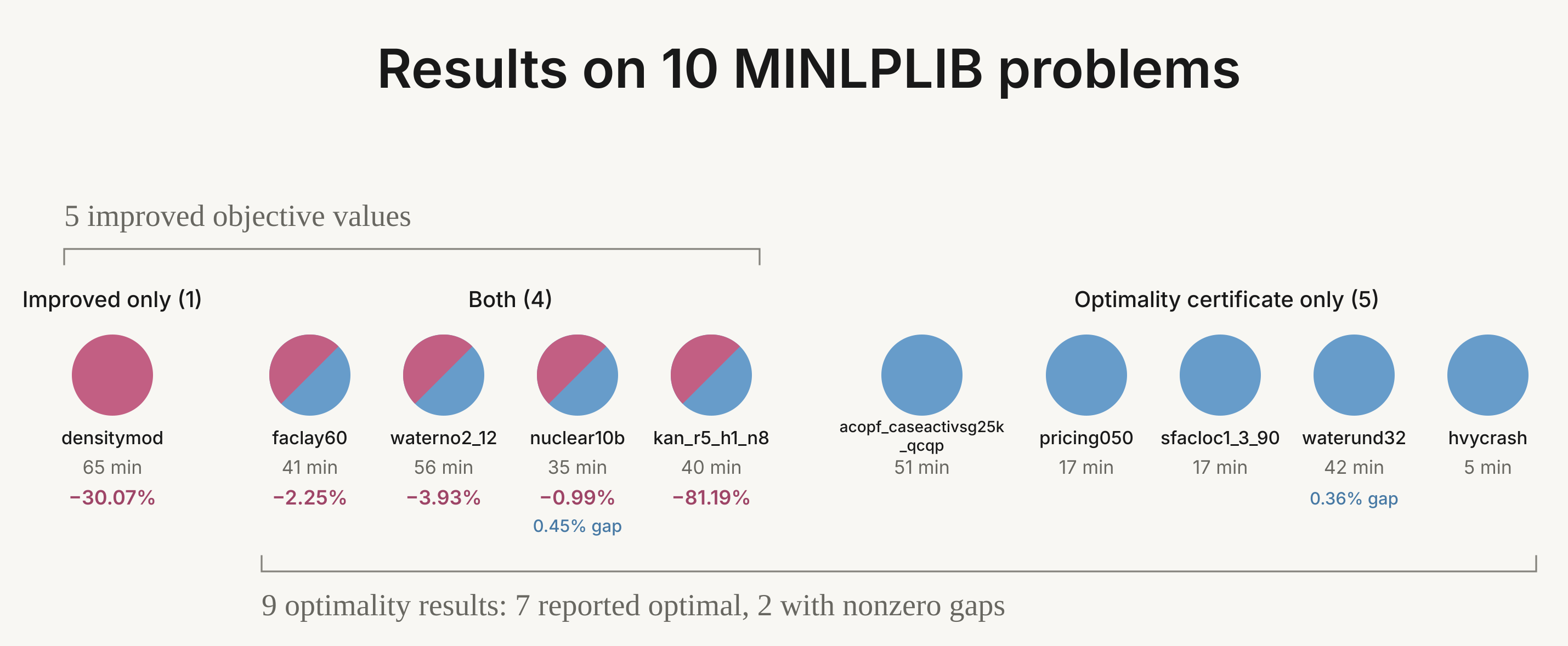
Many classical CS problems (bin packing, knapsack, scheduling, TSP, network design, etc.) are examples of MILP. Almost all decision problems can be formulated as MILP. I selected 10 open MILP problems from MIPLIB, where 9 years of work on commercial solvers and human-designed algorithms failed to find or prove optimal solution:
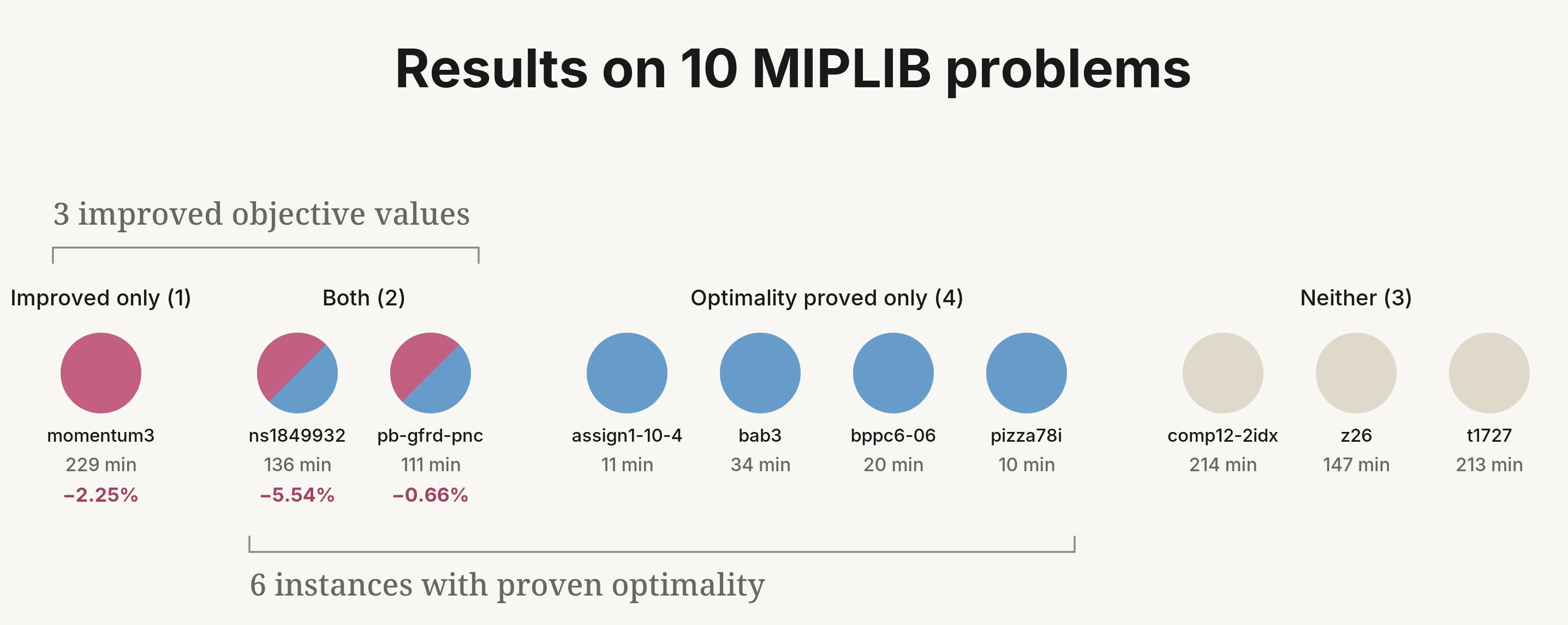
MILP illustration

Quadratic Programming

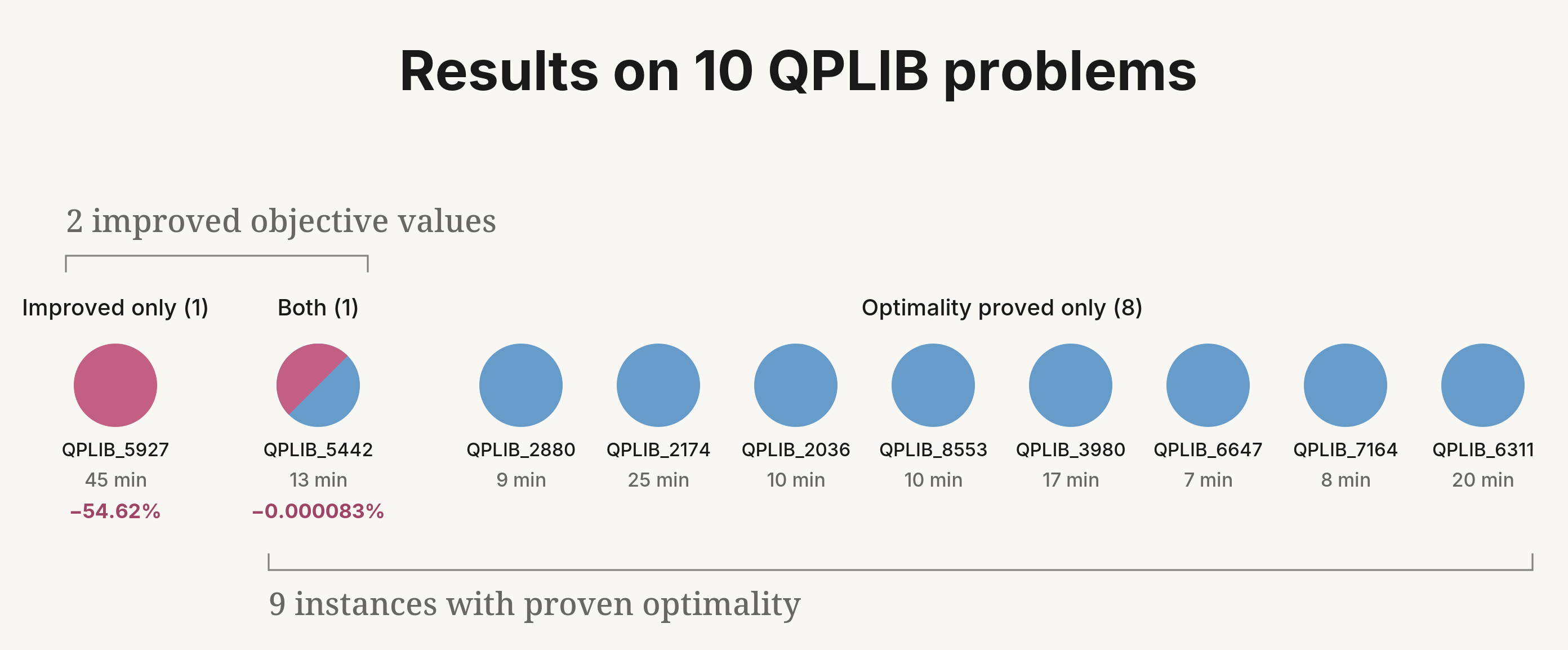
QP is an extension of MILP that allows quadratic objective functions.

QP illustration

Mixed-Integer Non-Linear Programming

Nonlinear optimization allows any objectives and constraints. This includes optimization of any neural networks, spaceships control, biological simulations. Astra vastly outperforms in proving lower bounds:

Nonlinear illustration

Semidefinite Programming

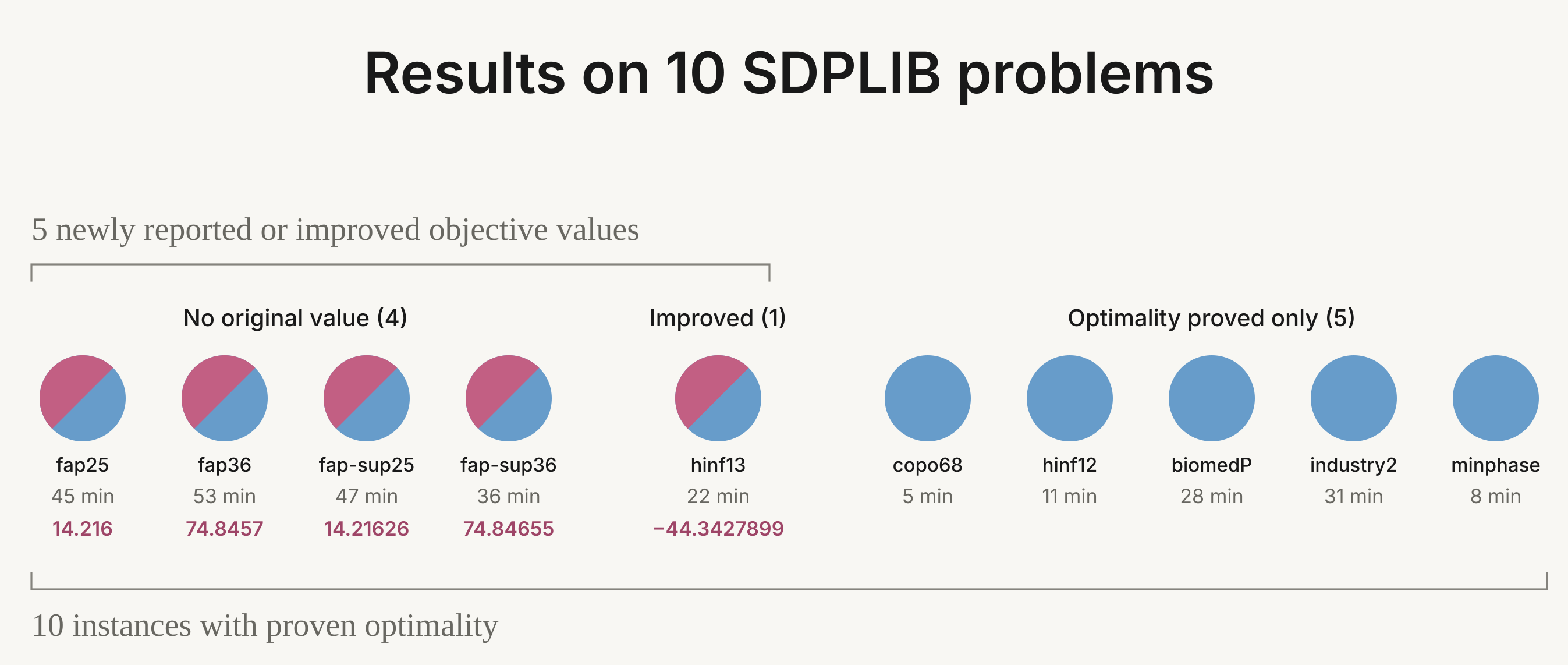
SDP is an extension of QP that allows semidefinite constraints. Astra fully solved 10 selected open SDP problems from SDPLIB:

SDP illustration

Large-Scale Optimization

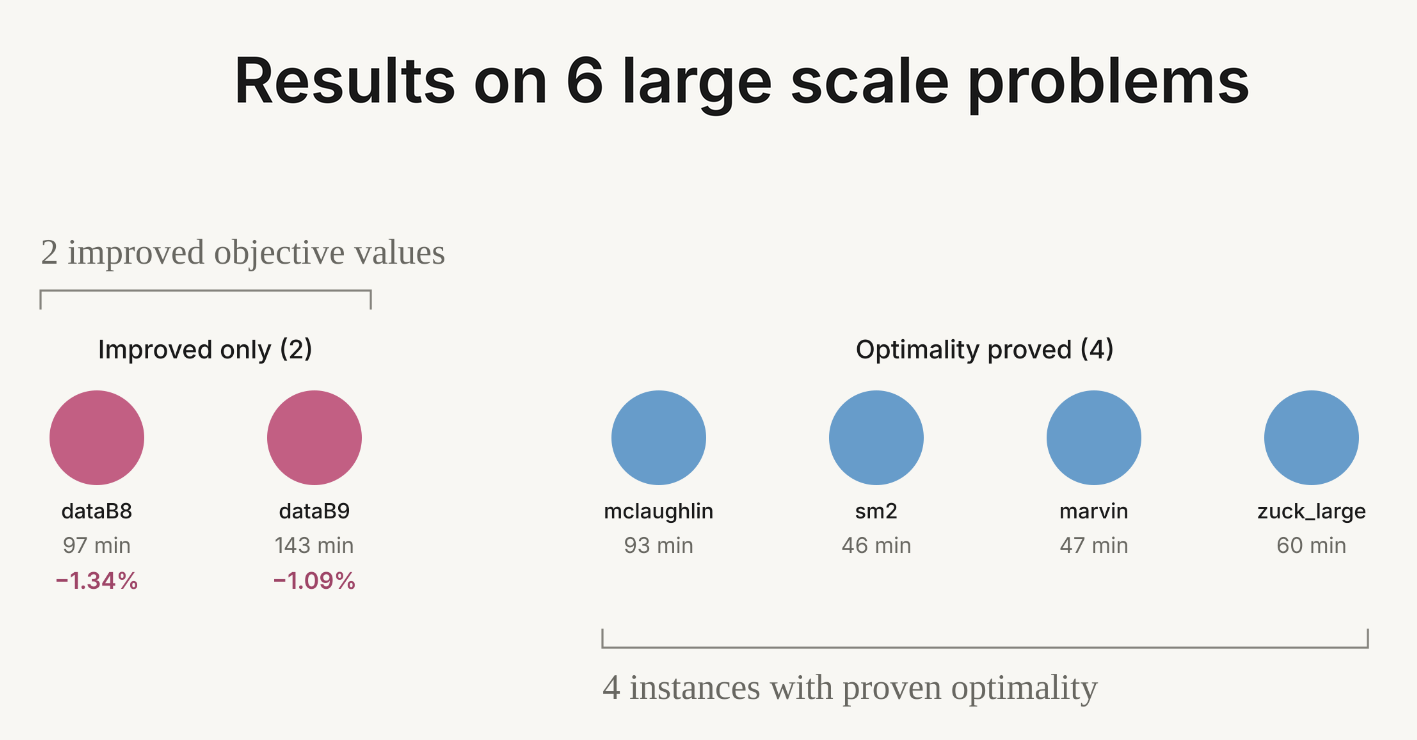
I also verified that agents do not struggle when problem scale reaches millions of variables:

Large scale illustration

CNN on CIFAR-10

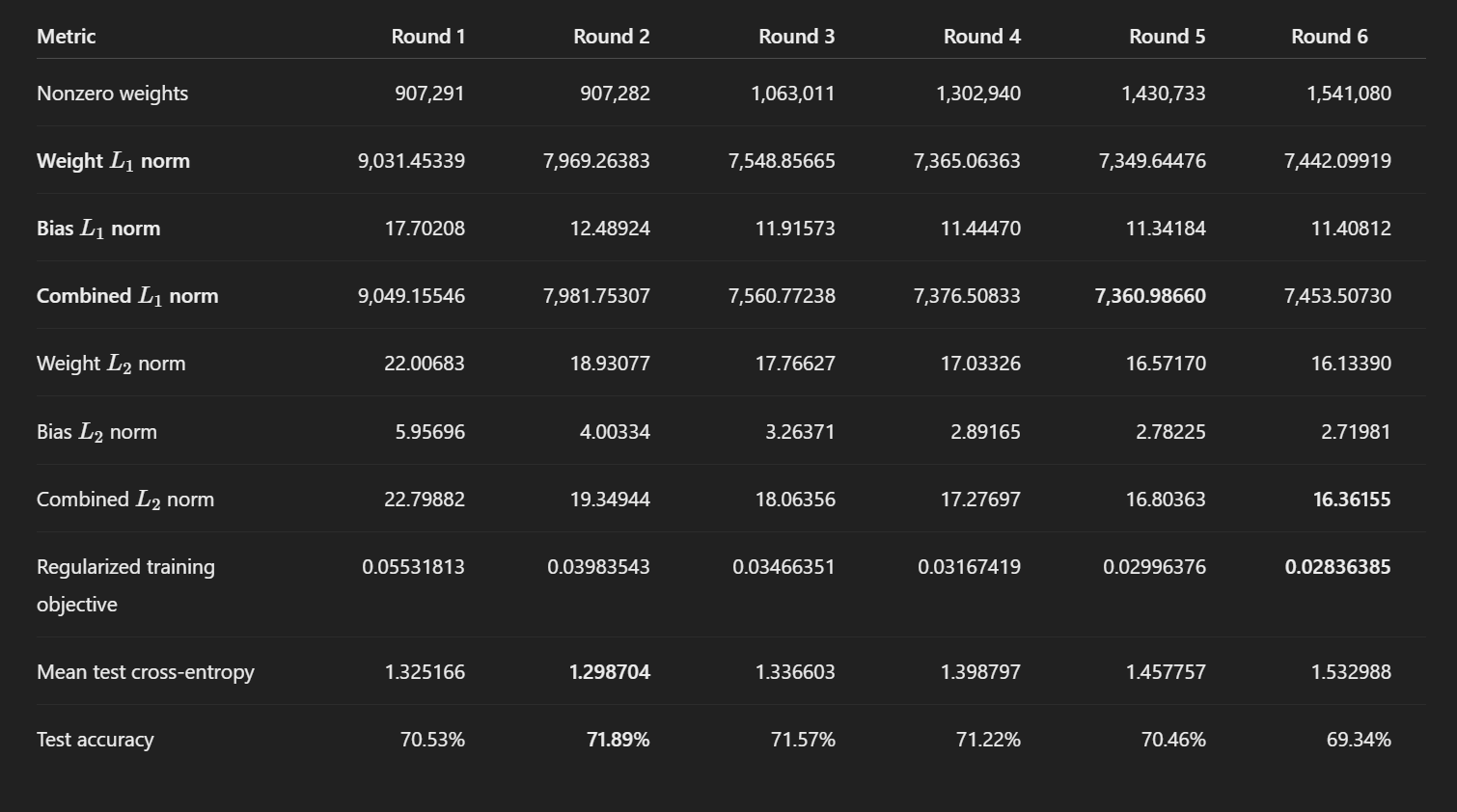
I also tested whether Astra can do well in neural network optimization. I gave it a 5-layer CNN with 4.6M parameters and asked it to minimize cross-entropy loss with 10^-4 L2 norm regularization.

CNN illustration

We can see that despite progress in L2-regularized objective (and 100% train accuracy), the CNN generalization was deteriorating and remained poor.

Remarks

  • Single agent of Astra 6.2 Max was used for each problem with an average runtime of 30 minutes. The prompt was "[attached file with objective and constraints] This is an MILP/QP/MINLP/SDP problem. Your task is to discover and prove best possible lower and upper bounds in this problem. Note that you should design custom specialized algorithms to achieve this."
  • The model was allowed to search the internet. Problems were chosen to be open (no optimal solution and bounds reported on the internet), of varying scale (between hundreds and millions of variables), and of diverse application backgrounds. In a small number of cases, optimal solutions were already mentioned in the literature outside of benchmark websites.
  • The model answers were a mix of custom heuristics, tree searches, ingeniously designed proofs, and the use of open source LP solvers (such as scipy lp solve).